Atomistic Structure II
Slides
Lecture Video
This lecture has been recorded using Zoom. Please use this link to access the Zoom recording.
Passcode will be sent through Canvas announcement. You might need to use your NUS email to login.
Content
In this chapter, we expand our discussion on atomistic structures by first examining the site properties characterizing crystalline materials. Building on the foundational concepts previously addressed, the focus shifts toward understanding local atomic environments and their influence on overall material behavior.
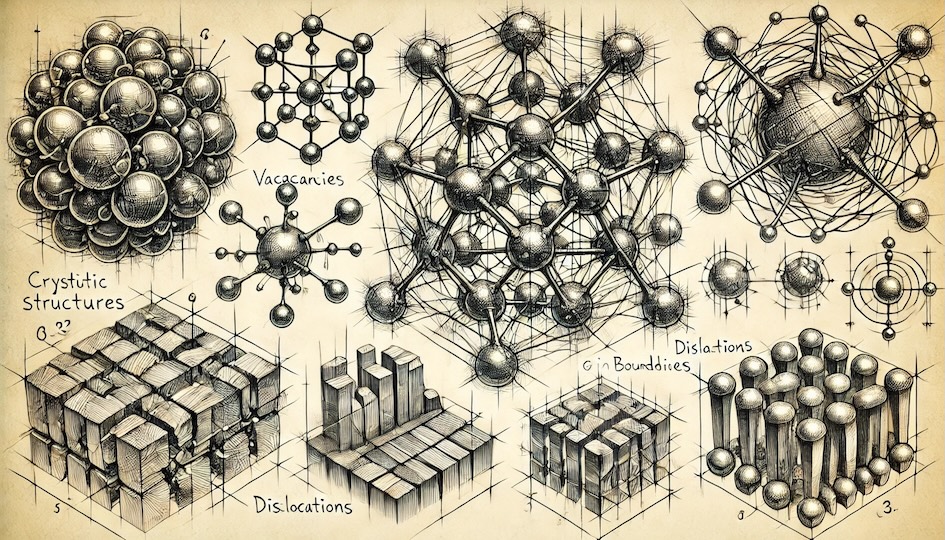
Following this, the chapter delves into the principles of defects and interfaces, emphasizing their critical roles in defining material properties. Defects, which represent deviations from an ideal crystal lattice, and interfaces, which serve as boundaries between distinct material regions, are analyzed in detail to elucidate their effects on mechanical, electrical, and thermal performance.
Subsequently, the discussion transitions to the representation of molecular structures and the unique challenges posed by non-crystalline (amorphous) materials. The absence of long-range order in amorphous systems necessitates alternative structure descriptors, and this text introduces several key methodologies for effectively characterizing such disordered materials.
Learning Objectives
By the end of this week, you should be able to:
- Analyze and interpret site properties within a material’s structure.
- Explain the fundamental concepts of defects and interfaces in materials and their influence on material properties.
- Understand and utilize SMILES notation and graph representations to describe molecules.
- Apply appropriate structure descriptors for characterizing non-crystalline (amorphous) materials.