Introduction
Materials science has traditionally relied heavily on experimental trial-and-error, guided by intuition and serendipity. While this approach has led to significant breakthroughs, it is inherently slow and expensive. The sheer number of possible materials combinations is staggering. Consider the periodic table: even if we restrict ourselves to, say, 30 elements commonly used in materials, and consider compounds with up to four different elements, we are faced with millions of potential materials. Exploring this vast chemical space experimentally is simply not feasible.
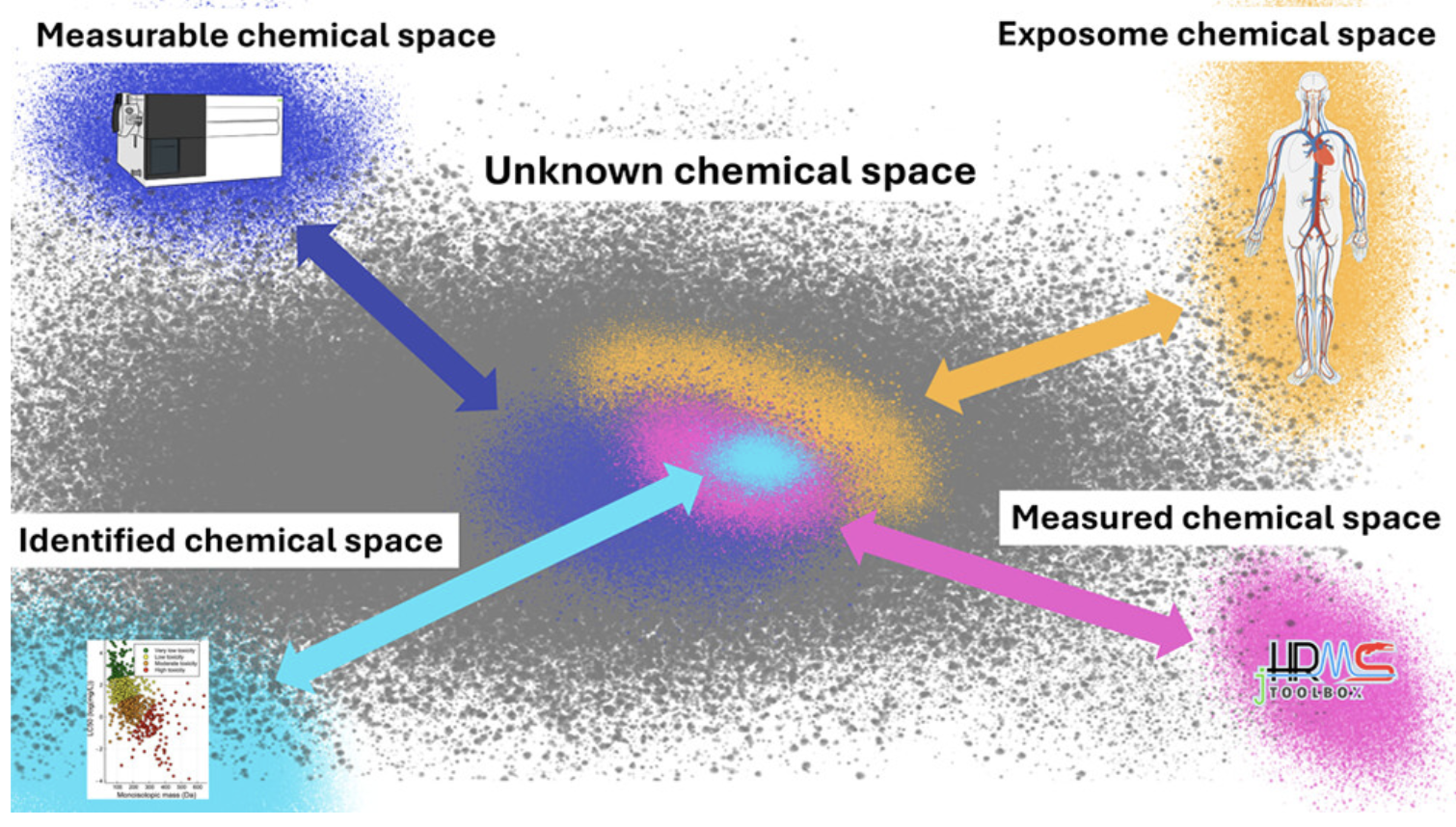
Chemical space is vast and complex, with many possible combinations of elements and structures. Image by Samanipour et al..
This limitation motivates the need for accelerated materials discovery, a paradigm shift that leverages computational power and high-throughput techniques. Instead of synthesizing and characterizing one material at a time, we aim to computationally screen thousands, or even millions, of candidate materials in silico, identifying the most promising ones for further experimental investigation. This is the essence of high-throughput simulation.
High-throughput simulations are a powerful tool which allows us to explore a vast range of materials and conditions, and to predict the properties of materials that have not yet been synthesized. It is used to accelerate the discovery of new materials, and to understand the properties of materials that are difficult to study experimentally. It also breaks the big computational problem into smaller, more manageable pieces, allowing us to run many simulations in parallel, so that we can explore a large number of materials in a reasonable amount of time.
Typical tasks in high-throughput simulation include: rapid screening of mateirals for desireable properties, systematic exploration of structure-property relationship, and discovery of new materials by mapping stability and performance trends.
- Samanipour, S., Barron, L. P., van Herwerden, D., Praetorius, A., Thomas, K. V., & O’Brien, J. W. (2024). Exploring the Chemical Space of the Exposome: How Far Have We Gone? JACS Au, 4(7), 2412–2425. 10.1021/jacsau.4c00220