Model and Modelling
A model is a simplified representation of a system, process, or phenomenon that is used to understand and predict the behavior of the system or process. Models can be physical, mathematical, or conceptual, and they are used in a wide range of fields, including science, engineering, economics, and social sciences.
Modelling is the process of using models to represent and understand the behavior of a system or process. Modelling involves simplifying complex systems into manageable components, identifying key variables and relationships, and developing mathematical or computational representations of the system. Modelling can be used to explore the behavior of systems that are too complex or difficult to study directly, to test hypotheses and theories, and to make predictions about future behavior. Modelling is an essential tool in many scientific disciplines, including physics, chemistry, biology, and engineering, and it is used to study a wide range of phenomena, from the behavior of individual molecules to the dynamics of entire ecosystems.
In materials science, models and modelling are used to study the structure, properties, and behavior of materials at the different length and time scales. For example, crystal structures can be modelled using mathematical representations of the atomic positions and interactions, and the properties of materials can be predicted using computational models based on quantum mechanics or classical mechanics.
Time and Length Scales
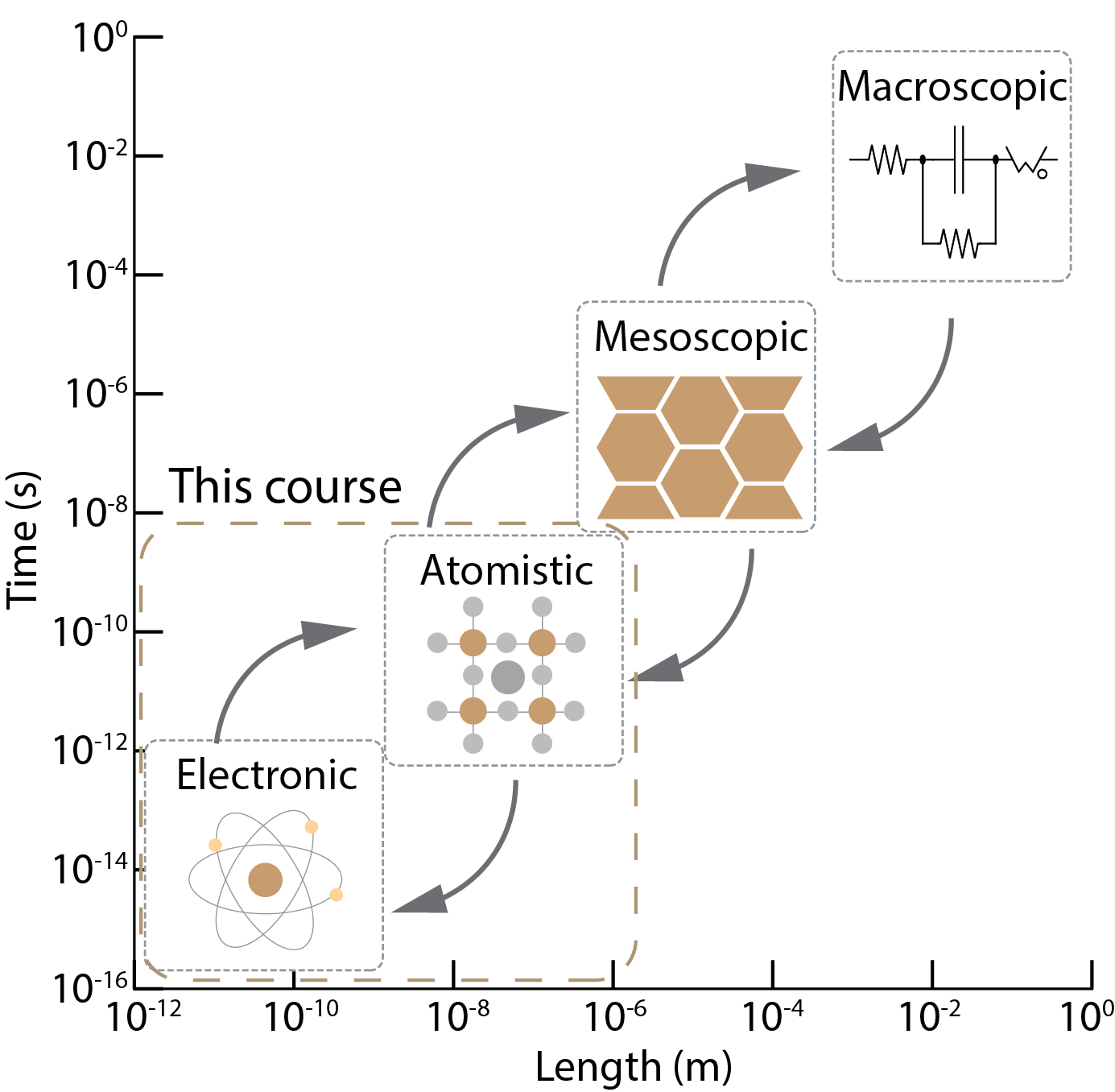
Multiscale modelling in materials science as a function of time and length scales. From electronic to macroscopic scales, different models and techniques are used to study the behavior of materials at different scales. In this course, we will focus on the electronic and atomistic scales.
Materials exhibit behavior at different length and time scales, and models and modelling are used to study this behavior at each scale. In materials science, the behavior of materials can be studied at the electronic scale, the atomistic scale, the mesoscale, and the macroscale, respectively. This course will focus on the electronic and atomistic scale.
At the electronic scale (fs, and Ångstrom), the behavior of materials is governed by the interactions between electrons and nuclei, usually described by quantum mechanics. Models based on quantum mechanics are used to study the electronic structure of materials, including the distribution of electrons and the formation of chemical bonds. First-principles (or ab-initio) density functional theory (DFT) is usually applied at this scale to study the electronic structure of materials and to predict their properties.
At the atomistic scale (ps to ns, and nm), the behavior of materials is governed by the interactions between atoms and molecules, usually described by classical mechanics. Models based on classical mechanics are used to study the structure and dynamics of materials at the atomic scale, including the arrangement of atoms in crystals and the motion of atoms in response to external forces. Force fields are a widely used technique in this scale that is based on classical mechanics and is used to study the interactions between atoms and molecules in materials.
At the mesoscale (s to ms and m to mm), the behavior of materials is governed by the interactions between grains, phases, and defects, usually described by continuum mechanics. Models based on continuum mechanics are used to study the mechanical, thermal, and electromagnetic properties of materials at the mesoscale, including the deformation of materials under stress, the diffusion of atoms in solids, and the growth of grains and phases. Finite element method (FEM) and phase-field method are widely used techniques in this scale to study the behavior of materials.
At the macroscale (s and m, or larger), the behavior of materials is governed by the interactions between components and systems, usually described by macroscopic laws and equations. Models based on macroscopic laws and equations are used to study the behavior of materials at the macroscale, including the response of materials to external stimuli, the performance of materials in engineering applications, and the behavior of materials in complex systems.
Multiscale Modelling
Multiscale modelling is an approach to modelling complex systems that involves integrating models at different length and time scales. Multiscale modelling is used in a wide range of fields, including materials science, biology, and engineering, and it is used to study systems that exhibit behavior at multiple scales. Multiscale modelling is an essential tool for studying complex systems that cannot be understood using a single model or approach.
The challenge of multiscale modelling is to develop models that capture the behavior of a system at each scale and to integrate these models into a coherent framework. This often involves developing models that are based on different physical principles and that operate at different levels of detail.