Materials Database

Examples of experimental (ICSD, CSD) and computational databases (Materials Project and AFLOWLIB) in materials science.
Here, we will introduce some materials databases. These databases contain data on the properties, characteristics, and behavior of materials, allowing researchers, engineers, and designers to access valuable information for their work.
Experimental Databases
Inorganic Crystal Structure Database (ICSD)
The Inorganic Crystal Structure Database (ICSD) is a comprehensive database of inorganic crystal structures. It contains information on the atomic coordinates, unit cell parameters, and crystallographic data of various inorganic materials. The ICSD is widely used by researchers in materials science, chemistry, and physics to study the structural properties of materials and to predict their behavior under different conditions. The database is continuously updated with new data from experimental studies, making it a valuable resource for materials research and development.
Cambridge Structural Database (CSD)
The Cambridge Structural Database (CSD) is a repository of crystal structures. It contains detailed information on the three-dimensional arrangements of atoms in organic and metal-organic compounds. The CSD is widely used by researchers in chemistry, biochemistry, and materials science to study the structure-property relationships of molecules and to design new materials with specific properties. The database is continuously updated with new crystallographic data, making it a valuable resource for structural analysis and materials design.
Crystallography Open Database (COD)
The Crystallography Open Database (COD) is an open-access database of crystal structures. It contains information on the atomic coordinates, unit cell parameters, and crystallographic data of various materials. The COD is maintained by the crystallographic community and provides free access to crystallographic data for research and educational purposes. The database is continuously updated with new data from experimental studies, making it a valuable resource for crystallographers, materials scientists, and educators. However, the COD is not as comprehensive as the ICSD or CSD, but it provides a valuable resource for open-access crystallographic data.
Computational Database
Computational databases contain data generated from theoretical calculations and simulations, e.g., density functional theory (DFT) calculations. These databases provide valuable information on the electronic, structural, and thermodynamic properties of materials, allowing researchers to predict and understand the behavior of materials at the atomic and molecular level. We will focus on the Materials Project in this lecture.
Materials Project
The Materials Project is a comprehensive database of materials properties and calculations. It is developed and maintained by researchers at the Lawrence Berkeley National Laboratory and other institutions. The Materials Project aims to accelerate materials discovery and design by providing a platform for computational materials science. It provides open access to computed information on known and predicted materials, including their structures, properties, and applications. The database is continuously updated with new data and features, making it a valuable resource for materials research and development. Currently (2025-02), the Materials Project contains data on over 169,000 materials and is widely used by researchers in various fields.
AFLOWLIB
The AFLOWLIB database is a high-throughput computational materials database that contains data on the electronic, structural, and thermodynamic properties of materials. It is developed and maintained by researchers at Duke University and other institutions. AFLOW provides open access to materials data generated from first-principles calculations, allowing researchers to explore and analyze the properties of materials at a large scale. The database is continuously updated with new data and features, making it a valuable resource for materials informatics and materials design.
Materials Selection
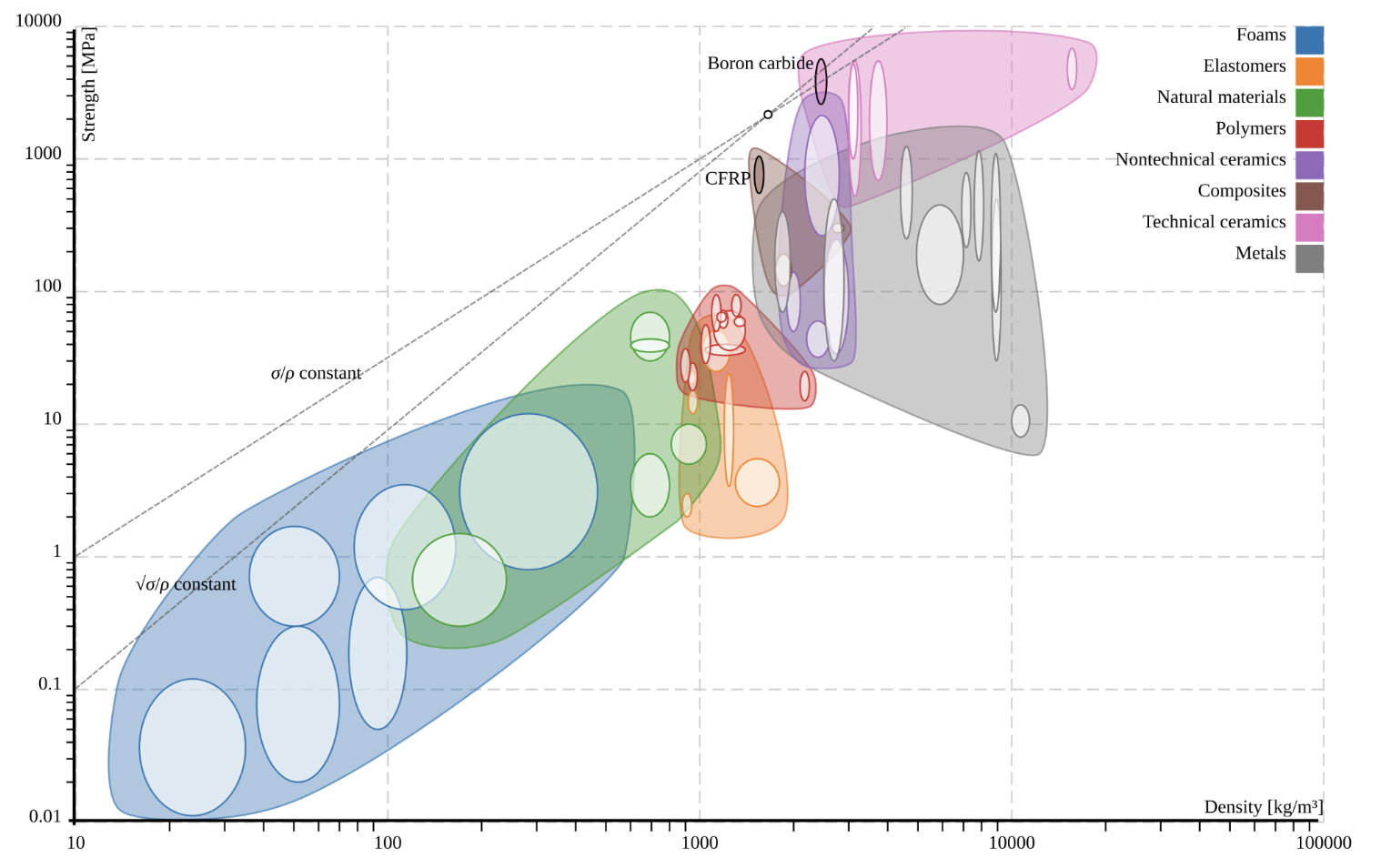
Ashby plot showing the Young’s modulus vs. density for various materials.
When selecting materials for a specific application, the primary objective is to find the best balance between performance, cost, and other constraints. This involves a thorough evaluation of various material properties to determine which material will provide the optimal solution for the intended use.
One effective tool for this evaluation is the Ashby plot, named after its developer Michael Ashby. An Ashby plot is a graphical method that allows engineers and scientists to visualize and compare different material properties. By plotting these properties on a graph, it becomes easier to identify which materials meet the desired criteria.
For example, if you are designing a component that requires specific mechanical properties, you might use an Ashby plot to compare materials based on their Young’s modulus and density. The plot would help you visualize which materials offer the best combination of stiffness and lightness. By examining the Young’s modulus vs. density plot, you can quickly identify materials that provide the desired mechanical performance while keeping the component lightweight, making it easier to narrow down your choices.
In addition to performance and cost, other factors such as availability, environmental impact, and manufacturability may also play a crucial role in material selection. By considering all these factors and using tools like the Ashby plot, you can make informed decisions that lead to the best possible material choice for your application.