History
Historical context is provided as optional reading. Materials informatics overview was covered in Week 1.
Computer Is the Foundation of Modern Digital Life
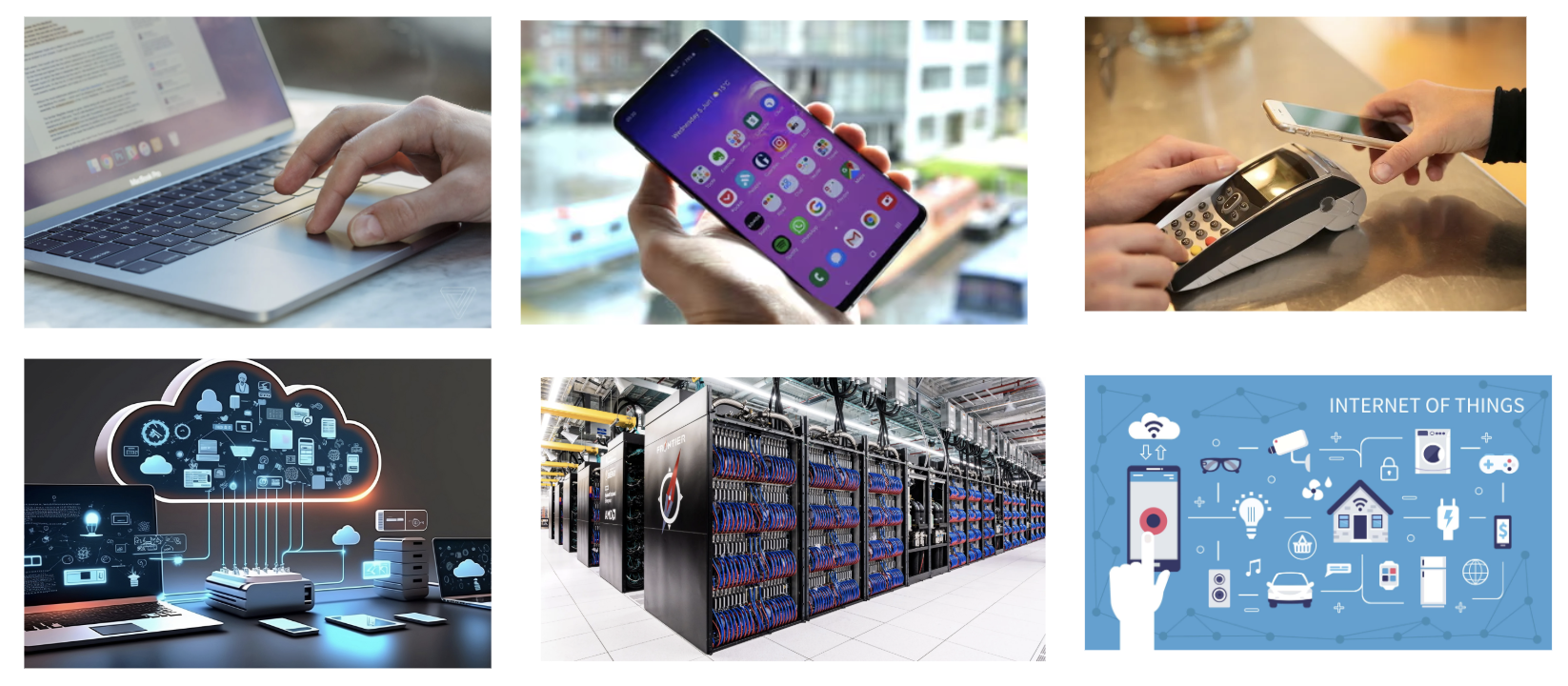
Some examples of computer in our daily life.
We will start from the basics of computer. Computer is everywhere in the digital era: calculator, smartphone, smart watch, workstation, laptop, supercomputer, cloud, inside electrical vehicles, trains, airplane etc. However the widespread of computer is only from mid-20th century. An understanding of computers is crucial to appreciate the opportunities and limitations in their application to science.
Early Days of Computer
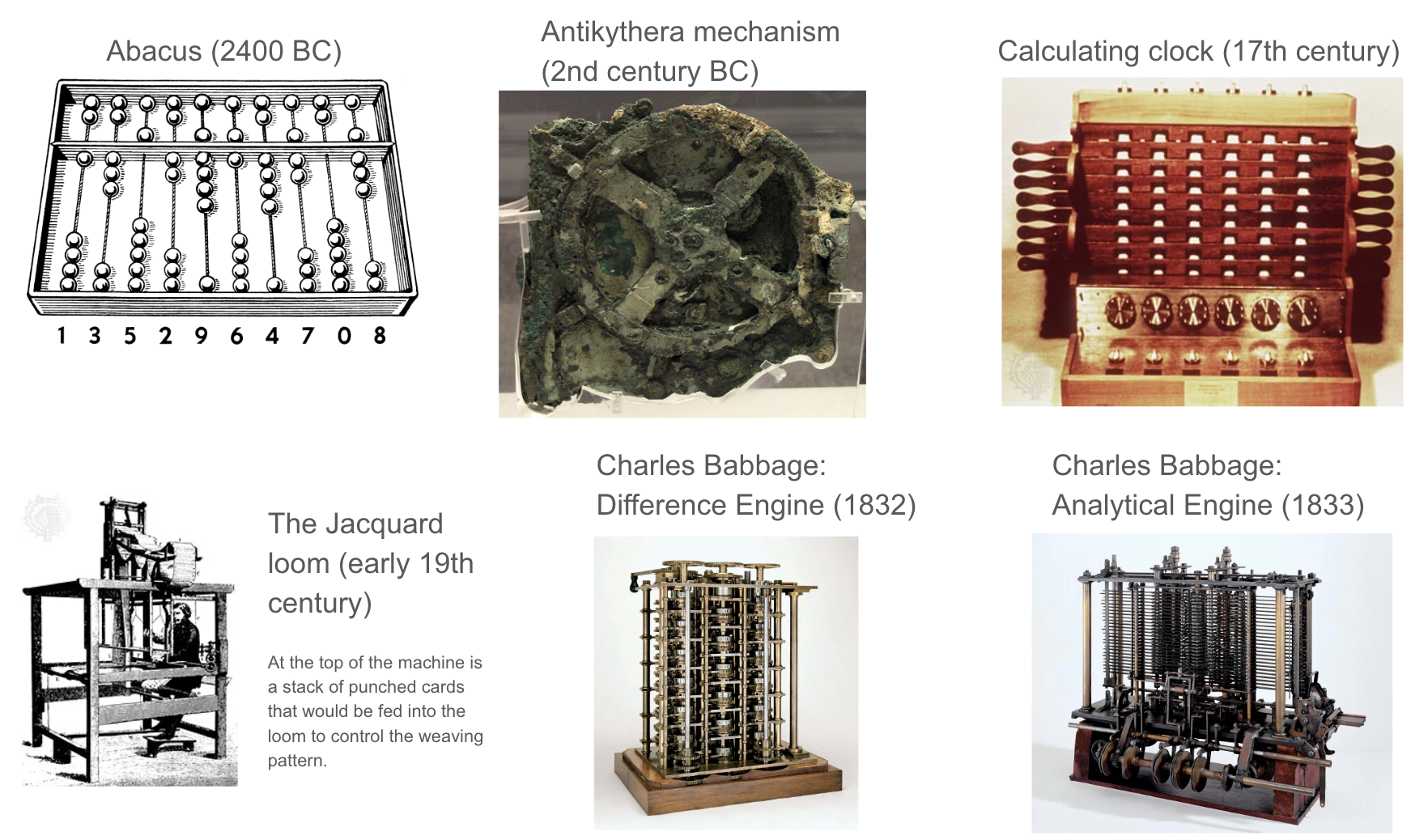
Some examples computer before 20th century.
The oldest example of a computer is the abacus, which dates back to 2400 BC in Asia. Following the abacus, the Antikythera mechanism, an ancient Greek hand-powered computational instrument for mathematical astronomy, is the oldest known analogue computer. In the 17th century, Wilhelm Schikard built the first calculator, and Johannes Kepler developed the prototype of the calculating clock. This device could add and subtract six-digit numbers, with a bell signaling seven-digit overflows, using six interlocking gears.
During the Industrial Revolution, the Jacquard loom emerged as a significant innovation. This textile-weaving loom could be considered the first practical information-processing device. It worked by pulling various-colored threads into patterns using an array of rods. By inserting a card punched with holes, an operator could control the motion of the rods and alter the weave’s pattern. The loom also featured a card-reading device that automatically inserted a new card from a pre-punched deck each time the shuttle was thrown, enabling the automation of complex weaving patterns.
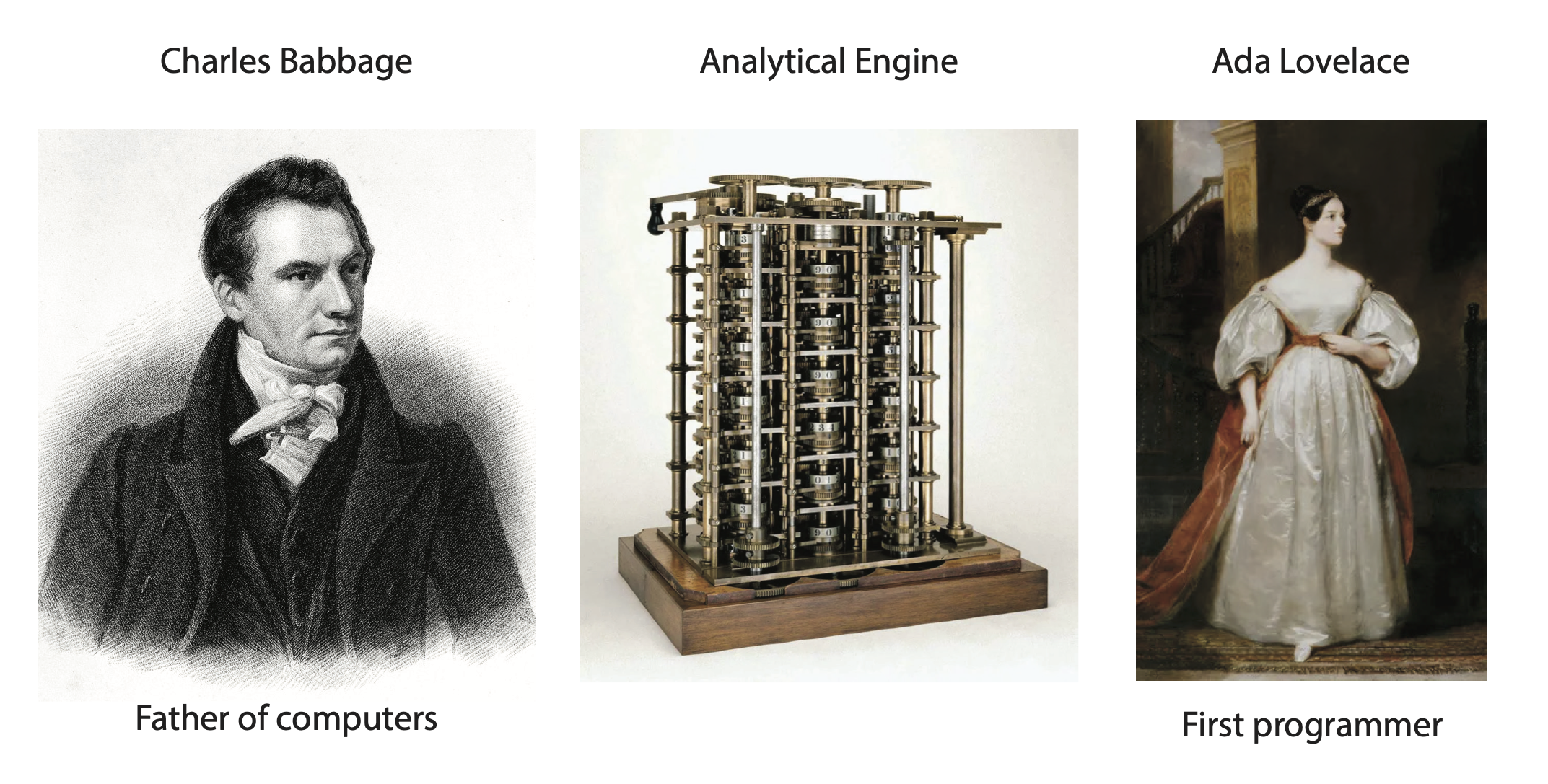
Charles Babbage, his Analytical Engine, and Ada Lovelace, the first programmer.
In the 19th century, Charles Babbage designed the first difference engine, designed to produce logarithm tables for navigation. He later improved this machine and introduced the Analytical Engine, a general-purpose, fully program-controlled, automatic mechanical digital computer. The analytical engine featured a calculating unit called the mill, analogous to the central processing unit (CPU) in modern computers. It also had a store for holding data prior to processing, similar to today’s memory and storage, and input and output devices known as the reader and printer.
Ada Lovelace, the daughter of Lord Byron, attended Babbage’s gatherings and became fascinated with his Difference Engine. She then started to contact with him and asking questions. She became the only expert on processing sequencing instructions on the punched cards used by the Analytical Engine, earning her the title of the world’s first programmer.
Analogue Computer
Prior the era of modern digital computer, there are analogue computers, which utilize continuous physical quantities such as electrical, mechanical, or fluid/hydraulic to model the problem being solved. The oldest known analogue computer is the 2000-year-old ancient Greek hand-powered orrery called Antikythera Mechanism. The machine is used to predict astronomical positions and eclipses decades.
The most limitation of analogue computer is noise, which limits its accuracy. It is also vulnerable to the environmental changes such as temperature and humidity. In addition, it is expensive to maintain the analogue circuits and mechanical devices. For example, these computers need regular recalibration and maintenance. Therefore, in the 1950s to 1970s, digital computers based on first vacuum tubes, transistors, integrated circuits and then micro-processors became more economical and precise, which led digital computers to largely replace analog computers. Nowadays, you can have a complete computers on a microchip (or chip) with the size of a coin, which is also called system on a chip (SoC).
Despite these challenges, there has been a resurgence of interest in analog computing, particularly in areas like quantum computing, optical computing, and neuromorphic computing. These technologies are seen as more powerful and energy-efficient alternatives to traditional digital computing.
Digital Computer
Digital computers offer several advantages, including high precision, flexibility, programmability, ease of data storage, and simple upgrades. The first programmable, electronic, general-purpose digital computer was the Electronic Numerical Integrator and Computer (ENIAC), developed in 1945. Most of the devices mentioned earlier, such as smartphones, laptops, and supercomputers, are digital computers. In this course, our computations will be conducted on digital computers.
Digital computers represent information in discrete form, typically as sequences of 0s and 1s, known as binary digits or bits. These computers are built using transistors, which are solid-state switches. Modern digital computers contain an astonishing number of transistors; for example, the Apple M4 chip has 28 billion transistors.
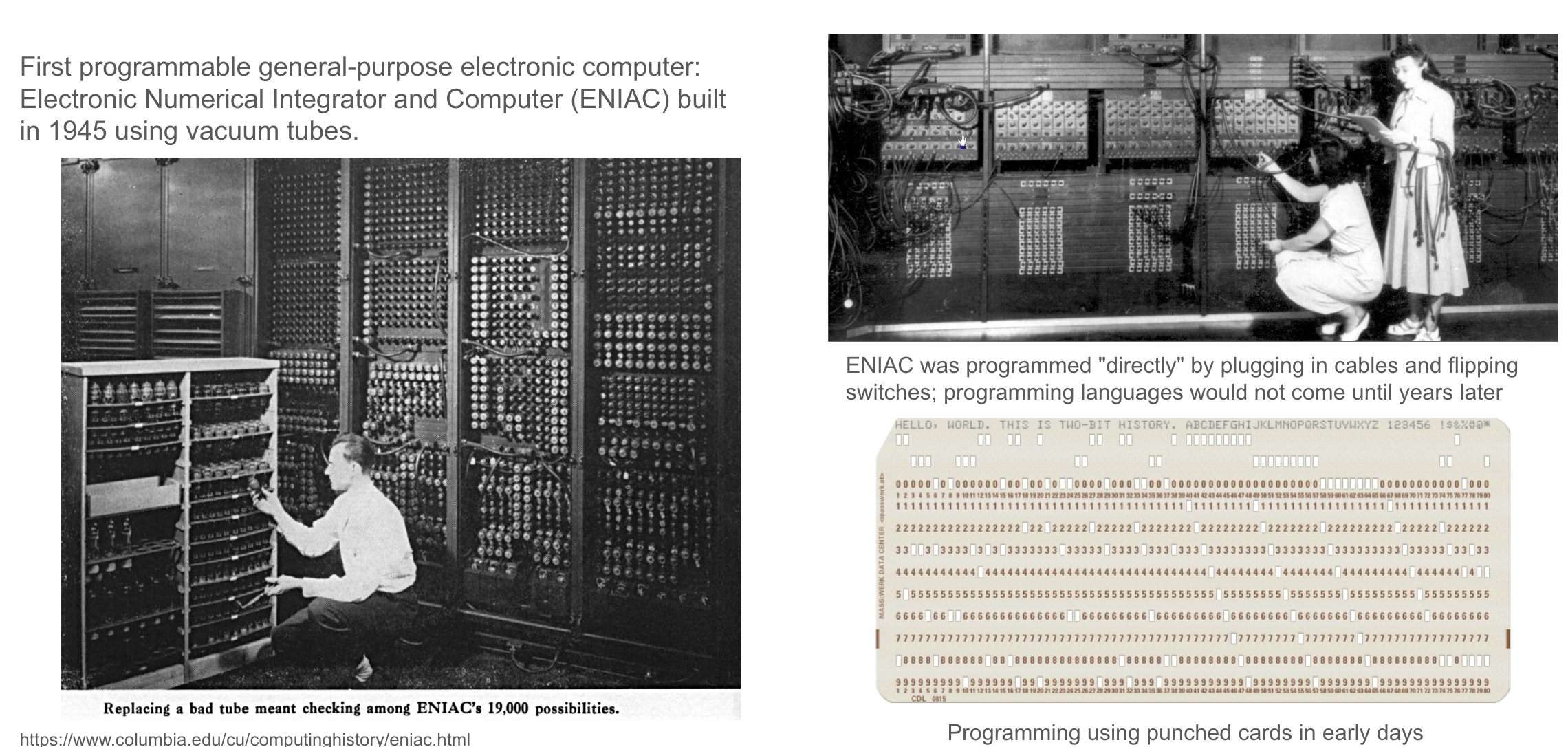
Early Days: General-Purpose Programmable Computer
The first programmable general-purpose electronic computer was the Electronic Numerical Integrator and Computer (ENIAC), built in 1945. ENIAC used vacuum tubes and was programmed by physically plugging in cables and flipping switches. This method of programming was quite cumbersome and complex, as programming languages had not yet been developed. In the early days, programming often involved using punched cards, which were fed into the computer to input data and instructions.